Who Is Nicki Minaj?
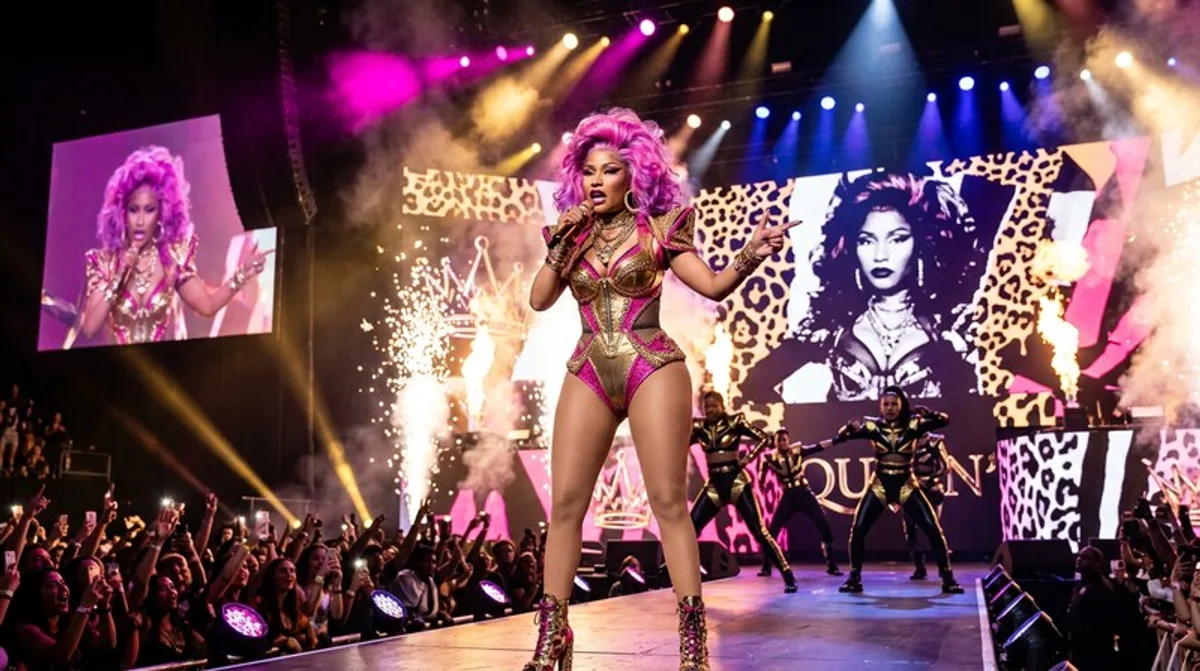
Onika Tanya Maraj-Petty — Nicki Minaj — is the first female rapper to appear on Forbes's Hip-Hop Cash Kings list, the first female rapper to simultaneously have seven songs on the Billboard Hot 100, and the artist who redefined what commercial viability looked like for women in hip-hop for an entire decade. Her debut album "Pink Friday" in 2010 debuted at number one, making her the first female solo rap artist to reach that position in the Nielsen SoundScan era — a statistical milestone that her team was careful to document, because the documentation itself became a marketing asset. With 227 million Instagram followers and an audience built across a career that predates the platforms it now dominates, Nicki Minaj represents a generation of artists who built cultural authority before social media existed and then converted it into digital-era commercial value more effectively than almost any of their peers.[1]
Latest videos · Open channel ↗
The Barbz — her fanbase — are among the most studied fan communities in pop culture academic literature, cited repeatedly as an example of parasocial identity formation, collective action, and the unusual ways that intense fanbase loyalty translates (and sometimes does not translate) to streaming numbers, chart positions, and commercial outcomes.
Early Life & Young Money Origins
Onika Tanya Maraj was born on December 8, 1982, in Saint James, Trinidad and Tobago, and moved with her family to Queens, New York, at age five. She attended LaGuardia High School of Music & Art and Performing Arts — the same institution that produced Lady Gaga, Jennifer Aniston, and Timothée Chalamet — where she studied theater. Her early career in New York's underground hip-hop circuit generated enough buzz that Lil Wayne signed her to Young Money Entertainment in 2009, one of the most consequential record deals in hip-hop history in terms of the commercial platform it provided.[2]
The mixtape years (2007–2009) — three volumes of "Playtime Is Over," "Sucka Free," and "Beam Me Up Scotty" — are studied in hip-hop scholarship as examples of how an artist can build industry credibility and audience loyalty simultaneously without label infrastructure. "Beam Me Up Scotty" was released independently and generated enough organic traffic that it was officially re-released by Republic Records in 2021, eleven years after its original distribution, still commercially viable.
Pink Friday Era & Commercial Records
"Pink Friday" (2010) debuted at number one on the Billboard 200 with 375,000 copies sold in its first week. It remained on the chart for 156 weeks — a record for a female rap album at the time — and produced "Super Bass," which became one of the best-selling digital singles of 2011. The album's commercial performance was built on a feature strategy: Nicki appeared on guest verses across dozens of albums in 2009–2010, generating enough recognition that her own release had a pre-existing audience before its first day of sales. That strategy — building recognition through high-volume features before releasing your own project — has since become a documented approach in hip-hop marketing, but she executed it at scale and speed that her contemporaries had not previously attempted.[3]
"Pink Friday: Roman Reloaded" (2012) debuted with over 253,000 first-week sales. "The Pinkprint" (2014) reached number two. "Queen" (2018) reached number two despite a release strategy that overlapped with Travis Scott's "Astroworld" — the chart battle between the two, and the public controversy that followed Nicki's claims about streaming manipulation, was one of the most-covered industry stories of that year.
Career Timeline
Collaboration History & Cross-Genre Reach
Nicki Minaj's feature list — Beyoncé ("Feeling Myself"), Ariana Grande ("Side to Side"), Madonna ("Give Me All Your Luvin'"), Kanye West, Drake, Lil Wayne, Katy Perry ("Swish Swish") — spans a range of genre contexts that is unusual for a rapper whose core identity is firmly hip-hop. The strategic value of cross-genre features is accumulation of audience segments that would not otherwise overlap: each collaboration introduces her to a listener base that has a different relationship with hip-hop than her core Barbz fanbase, and each generates a commercial event in multiple chart categories simultaneously.
"Side to Side" with Ariana Grande reached number four on the Hot 100 — her highest-charting single at the time — demonstrating that pop-crossover collaborations could deliver chart performance that pure hip-hop singles did not consistently reach in the mid-2010s format environment.
Brand Deals & Hip-Hop Commercial Authority
Nicki Minaj's brand deals have historically concentrated in fashion and beauty — MAC Cosmetics (multiple collections), Roberto Cavalli, H&M, Beats by Dre, and Pepsi — reflecting the brand-building strategy of an artist whose persona is anchored in visual extravagance. Her estimated Instagram post rate is $500,000–$1 million per placement. The MAC collaborations in particular were notable for sell-out performance: limited-edition Nicki Minaj lipstick collections sold out within hours of release, establishing her audience's purchase conversion rate as among the highest in the celebrity beauty collaboration category at the time. For benchmarks on how hip-hop celebrity rates compare to other entertainment categories, see our celebrity pricing breakdown and influencer rate guide.
The commercial principle her career demonstrates is that chart dominance and brand deal premiums are correlated but not identical: her peak chart years (2010–2012) commanded brand deals that her streaming-era numbers have not fully matched, because the brand premium reflects cultural moment as much as follower count. How that dynamic affects deal structure over a career is something every long-term creator faces.
Related Creators
Cardi B is the most-discussed comparison and contrast in contemporary hip-hop: both are femcees from New York with massive chart success, but Cardi's rise through reality television (Love & Hip Hop) versus Nicki's through underground mixtapes represents a generational debate about authenticity, commercial versus critical credibility, and what female rap's relationship with mainstream pop means for the genre. The tension between them is genuine and documented, which makes them the most-studied celebrity rivalry in contemporary music. Beyoncé represents the peak of the crossover career trajectory — "Feeling Myself" was a collaboration between the two most commercially powerful Black female artists of their respective generations, and the commercial and cultural weight of that single was inseparable from the equality it implied. Ariana Grande's "Side to Side" collaboration illustrates how pop-crossover features expanded Nicki's chart ceiling in ways that hip-hop-only releases did not.
For rates and benchmarks in this creator category, see our music influencer rates.
Sources
- 1 Forbes — Nicki Minaj: Hip-Hop's Highest-Earning Woman (2012)
- 2 Rolling Stone — Nicki Minaj: The Complete Story (2019)
- 3 Billboard — Nicki Minaj's Complete Chart History (2022)
Platform Statistics
Channel Growth History
| Year | YouTube Subscribers | Monthly Views | Est. Annual Earnings |
|---|---|---|---|
| 2026 | 0 | 0 | $9.6M – $36.0M |
| 2022 | 0 | 0 | $9.6M – $33.6M |
| 2019 | 0 | 0 | $7.2M – $24.0M |
| 2015 | 0 | 0 | $2.4M – $7.8M |
Data sourced from Social Blade & public estimates. Updated annually.
Estimated Sponsorship Rates
Market estimates — actual rates vary by deal structure & exclusivity
Brand Deals & Sponsorships
| Brand | Year | Deal Type | Source |
|---|---|---|---|
| MAC Cosmetics | 2016 | Collab Collection | Press Release |
| Beats by Dre | 2012 | Brand Campaign | Press Release |
| Fendi | 2019 | Brand Campaign | Press Release |
Frequently Asked Questions
Nicki Minaj's real name is Onika Tanya Maraj-Petty.
Nicki Minaj was born on December 8, 1982, and is 43 years old as of 2026.
Nicki Minaj's net worth is estimated at $100 million, based on platform ad revenue, brand partnerships, merchandise, and business ventures. This is an estimate — exact figures are not publicly disclosed.
Nicki Minaj is American, born in Saint James, Trinidad and Tobago.
Nicki Minaj — Official Social Media & Links
All accounts below are the verified official profiles for Nicki Minaj. Follower counts are approximate and updated periodically.
Sponsorship Rates & Booking
- Youtube: 26M followers
- Instagram: 215M followers
- Tiktok: 16M followers
- Twitter: 22M followers