
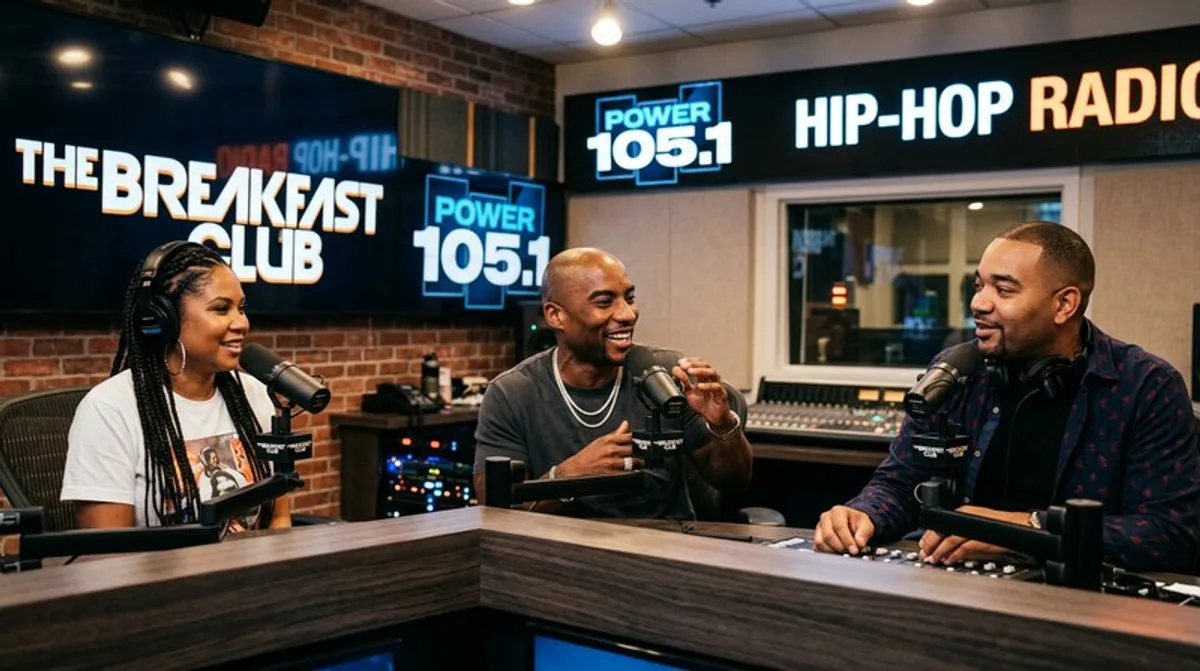
Who Is The Breakfast Club?
The Breakfast Club is the Power 105.1 FM morning show that became — through the collision of New York hip-hop radio culture, three hosts with radically different energies, and a decision to document everything on YouTube beginning around 2010 — the most-watched hip-hop interview program in the world, with 6.8 million YouTube subscribers accumulating a catalog of celebrity interviews that functions as the primary archival record of how hip-hop and R&B artists presented themselves publicly during the streaming era. The show's three hosts represent distinct institutional roles: Charlamagne tha God (Lenard Larry McKelvey, born June 29, 1978, in Moncks Corner, South Carolina) as the antagonist provocateur who asks the questions no publicist approved and whose "Donkey of the Day" segment became a cultural event in its own right; DJ Envy (Raashaun Casey, born September 3, 1977, in Queens, New York) as the DJ and straight-man anchor; and Angela Yee, who departed in August 2022 for her own show, having spent over a decade as the show's relationship intelligence and balance. The show is owned by iHeartMedia, which operates Power 105.1 out of New York City.
Latest videos · Open channel ↗
What The Breakfast Club built on YouTube that radio alone could not replicate is the specific visual record of how celebrities behave under pressure: the interviews where artists reveal more than they intended, the moments where Charlamagne's questions produce genuine emotional reactions, the "Donkey of the Day" call-outs that regularly generate more social media engagement than the original news event being discussed. The show's 6.8 million YouTube subscribers are not primarily radio listeners who also watch — they are a digital audience that encounters The Breakfast Club entirely through clips, viral moments, and full-length interview archives that have become the reference material for understanding hip-hop cultural debates from 2010 forward.
Origins: Power 105.1, Charlamagne's Antagonist Format & the YouTube Migration
The Breakfast Club launched on Power 105.1 FM in New York City around 2010, entering a morning radio format that had been dominated by multi-host shows built on entertainment and celebrity gossip and immediately distinguishing itself through Charlamagne tha God's confrontational interview style — asking follow-up questions that celebrities had not prepared for, challenging publicist-managed narratives directly, and performing the specific role of skeptical-audience-proxy that most entertainment journalists were unwilling to play because it endangered access. The show's decision to document its content on YouTube from its early years was prescient in a way that most radio properties did not recognize: morning drive-time radio has a three-hour window and a local geographic audience; YouTube has no time constraint and a global audience that discovers content through search and social sharing. The interview clips that became viral social media moments — Cardi B's first major sit-down, Drake explaining beef with Meek Mill, Kanye West's extended philosophical sessions — accumulated millions of views on YouTube while the radio broadcast was already archived and gone. The YouTube channel became the permanent record of conversations the radio show produced, and that permanence is what built 6.8 million subscribers across a decade of consistent interview documentation.[1]
"Donkey of the Day," Charlamagne's Books & The Hip-Hop Accountability Function
The "Donkey of the Day" segment — Charlamagne's daily on-air call-out of the person or institution whose behavior most deserved public criticism — became one of the most-replicated segment formats in hip-hop radio and produced standalone YouTube clips that regularly outperformed the full interview content in viewership. The segment's significance is structural, not just entertaining: it performs a specific accountability function within hip-hop culture that the genre's music press had historically avoided because it endangered advertising relationships and artist access. Charlamagne's willingness to call out both public figures and hip-hop artists specifically — including artists who were active collaborators with Power 105.1's music programming — established a credibility that purely celebrity-friendly shows could not match. His books, including "Black Privilege: Opportunity Comes to Those Who Create It" (2017) and "Shook One: Anxiety Playing Tricks on Me" (2018), extended his media identity beyond radio and YouTube into the book market, introducing The Breakfast Club's brand to an audience that reads about culture rather than listening to it on morning radio. Angela Yee's August 2022 departure to host her own programming, and the subsequent addition of new co-hosts, tested the show's structural resilience and confirmed that it had built an institutional identity beyond any single host's presence.[2]
Career Timeline
Brand Deals & Hip-Hop Radio Creator Economics
The Breakfast Club's estimated brand deal rate is $60,000–$180,000 per YouTube video placement, reflecting 6.8 million YouTube subscribers in the hip-hop and urban culture demographic — primarily Black American 18–45 with above-average urban market purchasing power and the demonstrated purchase intent that morning radio audiences historically deliver for sponsor categories. The show's combined radio and YouTube distribution means brand placements reach both the traditional morning radio listener (7–10 AM commuters on Power 105.1's New York and syndicated markets) and the YouTube archive viewer who may encounter the placement weeks or months after the original broadcast — providing extended commercial exposure that purely digital shows cannot match. Consumer brands targeting hip-hop and urban culture audiences (Sprite, State Farm, Amazon are confirmed historical partners), financial services expanding reach into underserved Black American communities, entertainment and streaming platforms, fashion and footwear, and consumer technology brands targeting young urban adults are the primary commercial categories. For entertainment and podcast creator rate benchmarks, see our influencer pricing guide and brand deal negotiation guide.
Related Creators
TED Talks' curated expert interview format and The Breakfast Club's confrontational celebrity interview format represent opposite ends of the interview content spectrum — TED produces the most credentialed, most prepared, most professionally staged expert presentations; The Breakfast Club produces the least scripted, most pressure-tested, most commercially raw celebrity conversations. Both have built million-subscriber YouTube audiences by understanding that their specific audience wants a very particular thing that only their format delivers: TED's audience wants to hear the world's best thinkers at their most cogent; The Breakfast Club's audience wants to hear famous people at their most unguarded. Both formats are irreplaceable because the audience experience cannot be replicated by any other format, which is the structural characteristic that sustains YouTube channels above 6 million subscribers through algorithm changes, cultural shifts, and platform competition. Vox's explanatory journalism approach to culture and politics and The Breakfast Club's accountability journalism approach to hip-hop culture both operate from the conviction that their audience deserves frank, informed analysis rather than access-protecting deference — both building loyal audiences by doing the work that mainstream media avoids.
Sources
- 1 New York Times — The Breakfast Club at 10: How a New York Hip-Hop Radio Show Became the World's Most-Watched Celebrity Interview Archive on YouTube (2020)
- 2 Rolling Stone — Charlamagne tha God: "Donkey of the Day," "Black Privilege," and the Radio Host Who Built Accountability Culture in Hip-Hop (2018)
Platform Statistics
Channel Growth History
| Year | YouTube Subscribers | Monthly Views | Est. Annual Earnings |
|---|---|---|---|
| 2024 | 0 | 0 | — |
| 2020 | 0 | 0 | — |
| 2014 | 0 | 0 | — |
Data sourced from Social Blade & public estimates. Updated annually.
Estimated Sponsorship Rates
Market estimates — actual rates vary by deal structure & exclusivity
Brand Deals & Sponsorships
| Brand | Year | Deal Type | Source |
|---|